

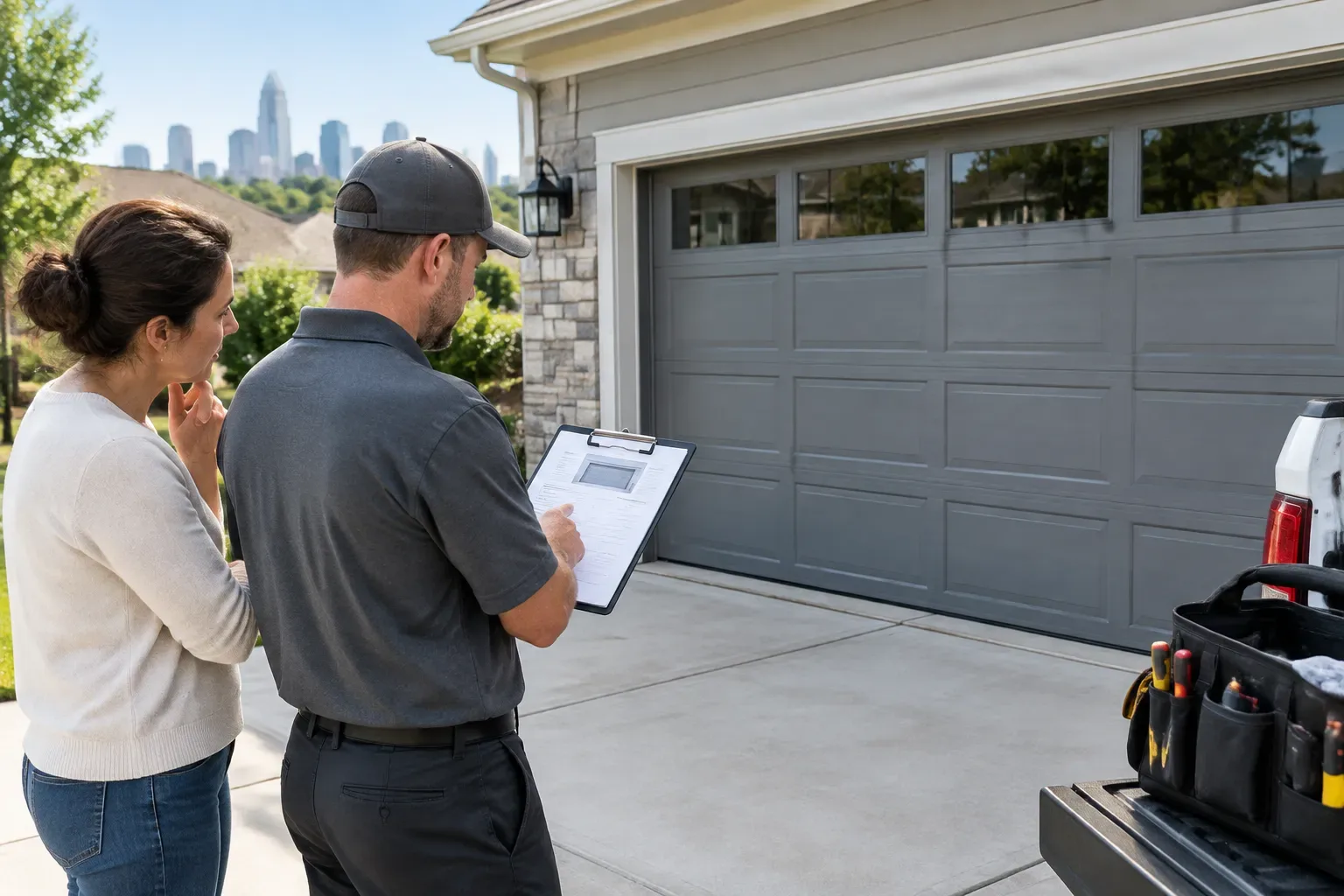
What Should Be Included in a Garage Door Installation Quote?
A complete garage door installation quote should identify the exact door and hardware being supplied, all installation labor, removal and disposal of the old system, opener work if applicable, taxes or possible permit-related charges, warranty terms, and anything excluded from the price. It should also state what could change after final measurements or an on-site inspection.
For Charlotte-area properties, a clear written proposal prevents a low initial total from becoming a series of add-ons. QuickFix Garage Door Service – Charlotte NC can help homeowners evaluate the full door system, not simply the visible panels.
Quick Answer
Before approving a quote, look for these essentials:
- Property and installer details, quote date, expiration date, and clear scope of work
- Door manufacturer, model or series, dimensions, material, color, insulation details, windows, and hardware finish
- Included system components, such as tracks, springs, cables, rollers, hinges, brackets, struts, and fasteners as applicable
- Labor for measurement verification, delivery, installation, adjustment, cleanup, and final safety testing
- Separate pricing for the door, hardware, opener, labor, removal, disposal, taxes, and optional upgrades
- Written exclusions, allowances, and change-order terms for hidden conditions or added work
- Manufacturer and installer warranty details, listed separately
A quote is easier to compare when every proposal describes the same scope. The lowest price is not necessarily the lowest total cost if it omits removal, seals, opener compatibility, or necessary corrections at the opening.
What door specifications should appear on the quote?
“New garage door” is too vague to support a meaningful comparison. The proposal should identify the brand or manufacturer and model or series when available, plus the door’s field-verified width and height. It should also name the material, number of sections, color or finish, window layout, and insulation construction or stated insulation rating.
Hardware details matter because a garage door is a moving system, not just a panel assembly. A useful quote identifies the included tracks, rollers, hinges, brackets, drums, cables, springs, bearing plates, reinforcement struts, and fasteners that apply to the selected configuration. This system-level approach reflects why industry technical and safety considerations address doors and operators as connected equipment, not as unspecified panels. See the DASMA technical data sheets for industry technical reference material.
For homes with attached garages, ask whether the quote includes new perimeter weather seals, a bottom seal, and any needed opening adjustments. Those details can affect drafts, rain entry, noise, and the connection between the garage and nearby living space.
Is the quote for a door only, a full system, or a door and opener package?
These scopes can all be valid, but they should not be compared as if they are the same product.
Door-only scope
This usually covers the replacement door panels and specified installation work. Confirm whether existing tracks, springs, and an opener are being reused, and whether that reuse has been evaluated for compatibility.
Full door-system scope
This includes the replacement door plus the applicable operating hardware, such as springs, cables, tracks, rollers, and related brackets. It is often the clearer option when current components are worn, damaged, mismatched, or not suitable for the new door.
Door-and-opener scope
This combines a new door system with an opener package. The quote should identify the opener model, controls, sensors, rail configuration, and features rather than using a general phrase such as “new motor.”
An existing opener may be suitable for reuse, but that decision should follow a compatibility check. The quote should say whether the opener will be reused, replaced, tested only, or excluded. If the opener itself has been unreliable, review this guide on whether to repair or replace a garage door opener before assuming a new door will resolve the issue.
What labor and installation work should be listed separately?
Labor should cover more than putting panels in place. A thorough garage door installation estimate explains whether the price includes final measurements, delivery and unloading, assembly, track and hardware installation, spring setup, adjustments, cleanup, and a walkthrough of basic operation.
Final testing should be named as part of the scope. Depending on the system, that can include door balance, travel limits, reversing function, photo-eye safety sensors, manual release operation, remotes, wall controls, and weather sealing. Safety-related product specifications and expectations are another reason to avoid a vague “installed” line item. The DASMA standards overview provides useful context on why product and operator details should be specific.
Do not treat a door that moves as proof that the installation is complete. A door can open and close while still needing adjustment or while an older opener has an unrelated fault. For concerns limited to an existing operator, garage door opener repair in Charlotte is a separate service discussion from a replacement-door quote.
Which removal, disposal, and cleanup charges should be clear?
The proposal should state exactly what happens to the old door, tracks, springs, opener equipment, and packaging. Removal and haul-away may be included, separately priced, or excluded. Each approach is acceptable when plainly disclosed, but an unclear quote makes it impossible to compare totals fairly.
Also ask who is responsible for moving stored items near the opening and whether the work area will be swept or cleared of normal installation debris. A contractor cannot always predict concealed conditions before disassembly, so the quote should distinguish routine cleanup from repairs caused by damage discovered behind the existing system.
What can legitimately change after the installer measures the opening?
A fixed price is useful only when its assumptions are clear. The quote should say whether it is final after field verification or subject to adjustment if the actual opening, framing, headroom, side room, ceiling clearance, electrical setup, or selected product differs from the initial information.
Common added-work categories include damaged framing, header reinforcement, masonry correction, opening-size changes, structural modifications, electrical outlet changes, ceiling obstructions, trim work, and replacement of incompatible components. These are not automatically required just because a new door is being installed. They become relevant only if inspection confirms a condition that affects safe installation or operation.
If a door is crooked, stops unevenly, or has visible damage, the symptom alone does not prove that replacement is the only answer. The cause could involve tracks, rollers, springs, cables, framing, or even an opener setting. A professional finding follows an inspection, and some electrical or structural concerns may fall outside routine garage door service. For an existing damaged system, a Charlotte garage door repair evaluation may help determine whether repair remains a practical alternative.
How should an opener be described if it is included?
An opener line item should identify the manufacturer and model, door compatibility or lifting capacity, rail or trolley configuration, and installation labor. It should also list included remotes, wall control, exterior keypad, safety sensors, battery backup if applicable, and Wi-Fi or smart-home features if selected.
Ask a separate question about each existing accessory. For example, will old remotes work? Is the existing keypad being retained? Are the photo-eyes new or reused? Is the current outlet adequate for the proposed setup? Details like these prevent a quote from appearing complete while leaving the most-used features unresolved.
A new opener is not always the right answer. If the door is structurally sound and the issue is isolated to the operator, repair may be more reasonable. Conversely, an old opener may not be compatible with the proposed door or may not justify additional labor. The quote should show that decision, not bury it.
How should Charlotte-area conditions and local requirements appear in the proposal?
Local details should be specific to the property, not assumed from a broad service area. Charlotte, nearby Mecklenburg County communities, and nearby South Carolina locations can have different jurisdictional processes. The quote should state whether the contractor or property owner will check and handle any applicable permits, inspections, taxes, or disposal requirements. It should not promise that no permit is needed without confirming the exact jurisdiction and project scope.
Material and seal specifications also deserve attention in the Charlotte region’s humid, rain-prone conditions, hot summers, and occasional freezing weather. Ask the installer to identify the door material, finish, exposed hardware, weather seals, and any maintenance assumptions. Moisture and temperature changes can affect finishes, seals, wood components, and hardware, but they do not replace the need for an on-site assessment.
For an attached garage, request a clear answer on perimeter sealing, bottom sealing, trim, and any framing corrections. Air leakage or water entry at the opening can affect adjacent spaces, so these items should not be left as an unspoken assumption.
How can you compare two installation quotes fairly?
Start with the written specifications, then compare totals. Two proposals may show similar prices while describing completely different door constructions, hardware packages, labor scopes, or warranty coverage.
- Match the exact door size, material, model or series, windows, finish, insulation description, and included hardware.
- Check whether each quote includes delivery, installation labor, removal, disposal, cleanup, seals, and final testing.
- Compare opener specifications separately, including controls, safety sensors, accessories, and reuse or replacement of existing equipment.
- Identify exclusions, allowances, possible change orders, taxes, and responsibility for local requirements.
- Read warranty terms by component and labor coverage, then ask for clarification before approving the proposal.
A simple comparison worksheet can prevent missed items:
| Quote item | Proposal A | Proposal B | What to verify |
|---|---|---|---|
| Door specification | Model, material, dimensions, finish | Model, material, dimensions, finish | Are the doors truly equivalent? |
| Operating hardware | Included components | Included components | Tracks, springs, rollers, cables, struts |
| Opener | Model and accessories | Model and accessories | Reuse, replacement, compatibility, controls |
| Labor and cleanup | Included work | Included work | Measurement, install, adjustment, testing, cleanup |
| Removal and disposal | Included or separate | Included or separate | Old door, tracks, opener, packaging |
| Conditions and exclusions | Listed items | Listed items | Framing, electrical, structural, permits, taxes |
| Warranty | Product and labor terms | Product and labor terms | Component coverage, duration, exclusions |
What warranty details should you ask for?
Warranty language should separate the manufacturer’s coverage from the installer’s workmanship coverage. Manufacturer coverage may differ for door sections, finish, hardware, springs, and opener components. Labor coverage may be separate, limited, or subject to conditions.
Ask for the covered component, warranty duration, exclusions, transferability, required maintenance, and the process for reporting a problem. Do not assume “lifetime” means every part and all labor are covered for the life of the home. The written terms control.
What is the most common quote mistake to avoid?
The most common mistake is approving a proposal based only on the bottom-line number. That approach can miss an excluded opener, old-door disposal, weather sealing, needed reinforcement, tax, or site-related correction. The result is often frustration when legitimate additional work appears later.
Instead, approve a quote only after you can explain what door and components are being installed, what work is included, what is excluded, and how a change would be authorized. A complete written scope gives you a fair basis for deciding between repair, replacement, and optional upgrades.
Ready to discuss your project?
Request a written Charlotte-area installation quote that clearly separates the door, labor, hardware, disposal, and any optional opener work.
FAQ
Does a garage door installation quote include labor?
It should say so explicitly. Look for labor covering measurement verification, delivery, installation, adjustments, cleanup, and final operational testing. Do not assume that a quoted door price includes all labor, removal, or setup. If labor is bundled into a package, ask for a written description of the tasks included and any conditions that could require additional work.
Should a quote include removal of my old garage door?
A complete proposal should state whether removal and disposal are included, separately charged, or excluded. Ask about the old panels, tracks, springs, opener parts, and packaging, since each may be handled differently. A lower quote can still be valid if removal is separate, but that cost needs to be visible before you compare it with another proposal.
Are tracks, springs, rollers, and cables included with a new garage door?
Not always. Some quotes are for the door sections only, while others include a full operating system. The proposal should list the components being replaced and identify anything that will be reused. If the current door has movement problems, visible wear, or impact damage, an inspection can clarify whether related components need attention. Learn more about garage door repair options in Charlotte when replacement is not the only possible path.
Is a garage door opener included when I buy a new door?
Only if the quote specifically includes one. A door and opener are related but separate purchases and installations. If an opener is included, request the model, rail configuration, controls, remotes, keypad, sensors, battery backup if applicable, and installation labor. If it is not included, the quote should explain whether the existing unit will be reused, tested, or excluded.
Why would a garage door quote change after measurements?
A quote can change if final measurements differ from the original information or if inspection finds conditions that affect installation. Examples include inadequate headroom, damaged framing, ceiling obstructions, electrical limitations, or incompatible existing hardware. The key is transparency: the original proposal should state that the price is subject to verification and explain how any added work will be approved through a change order.
Do I need a permit for garage door replacement in Charlotte?
Do not rely on a general answer. Requirements can depend on the property location, project scope, and jurisdiction, and nearby North Carolina and South Carolina communities may follow different processes. Ask the installer to state who will verify applicable local requirements and whether any permit-related or inspection-related costs are included, excluded, or not expected based on the current scope.
What warranty should come with a new garage door?
Ask for separate written details for the door sections, finish, hardware, springs, opener, and installation labor. Coverage can differ by component, and exclusions may apply to wear, damage, maintenance, or labor after a defined period. A useful quote identifies who provides each warranty and how a service issue is handled, rather than relying on a general warranty promise.
Should I repair my opener instead of replacing it with the door?
Sometimes, yes. If the current door is being replaced but the opener is compatible and functioning properly, reuse may make sense. If the opener has recurring faults, lacks needed safety features, or is not suited to the new door, replacement may be worth considering. This guide to professional opener repair and smooth operation explains why the operator should be evaluated on its own condition.