

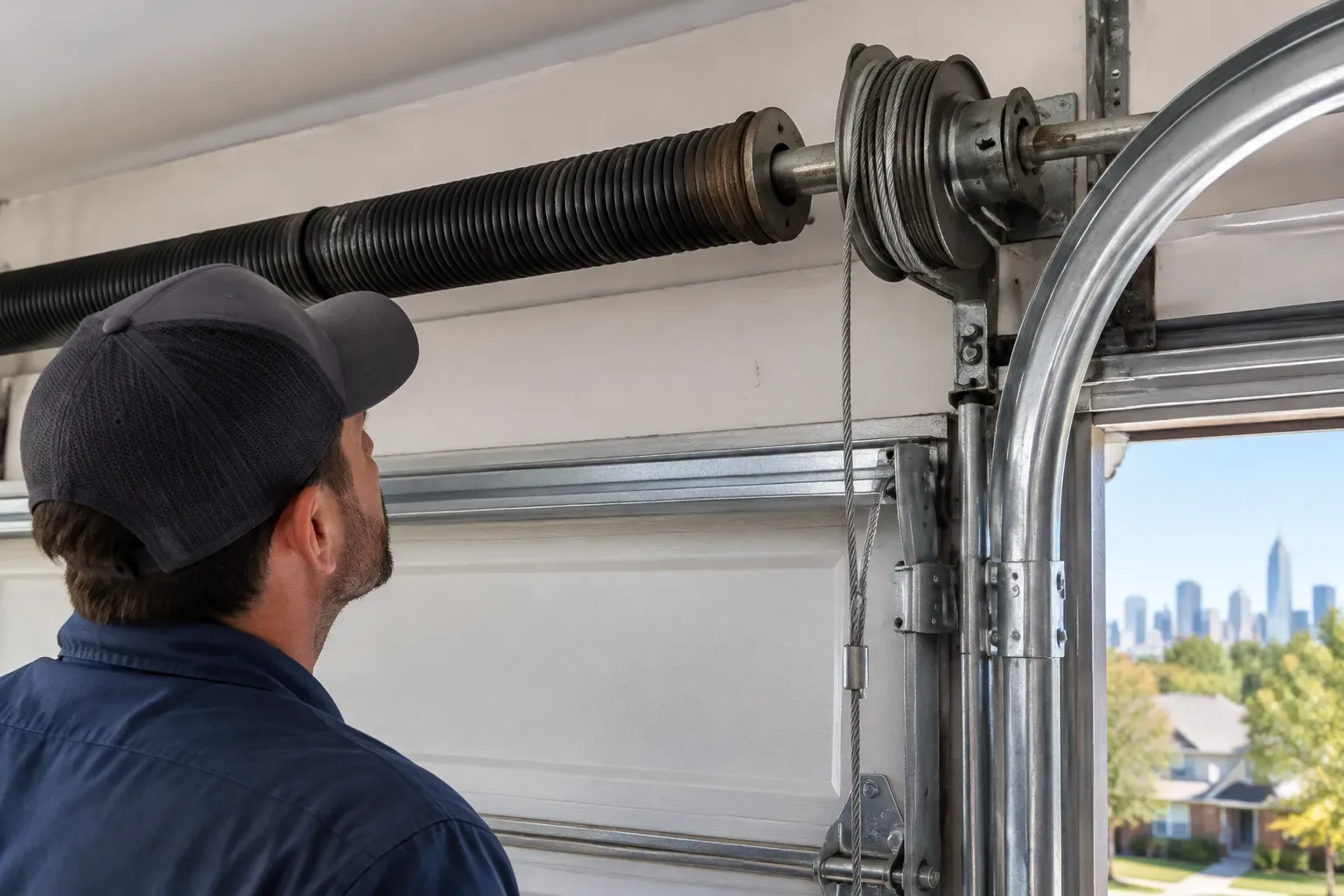
Why Did My Garage Door Cable Come Off the Drum or Pulley?
A garage door cable usually comes off its drum or pulley because the door is no longer moving evenly. A broken or weakened spring, a door that has become unbalanced, a bent track, seized rollers, damaged drum hardware, or a frayed cable can let one side lose tension and slip out of its proper path. The result is often a crooked, stuck, or visibly loose door.
Stop using the door and avoid trying to rewind the cable yourself. The cable works with a spring system that stores substantial force, and running the opener or forcing the door can turn a contained problem into damage to the tracks, panels, opener, or lifting hardware. QuickFix Garage Door Service – Charlotte NC provides garage door service for residential and commercial properties in Charlotte and surrounding communities.
Quick Answer
A cable off the drum is a symptom, not a complete diagnosis. It may have slipped because a spring failed, the door traveled crookedly, a roller or track bound up, the drum is worn, or the cable itself is damaged. Leave the door in its current position if possible, keep people clear of the opening, and arrange an inspection before operating it again.
What causes a garage door cable to come off the drum?
The cable wraps around a grooved drum near the torsion spring shaft as the door opens and closes. That routing keeps both sides of the door lifting together. If one side meets more resistance or loses support, the cable can go slack, overlap, fray, or come completely off the drum.
Several conditions can lead to that outcome:
| What you notice | Possible cause | What an inspection needs to confirm |
|---|---|---|
| One side of the door hangs lower or the door looks crooked | Loss of spring support, a cable that slipped, or uneven travel | Spring condition, cable routing, drum alignment, and door balance |
| Cable is loose or wrapped unevenly around the drum | Door was operated while out of level, incorrect adjustment, or drum wear | Cable tension, drum grooves, shaft position, and fasteners |
| Frayed, rusty, kinked, or unraveling strands | Cable wear or corrosion | Whether the cable and end fittings need replacement, plus the source of abnormal wear |
| Door scrapes, binds, or pops while moving | Bent track, worn roller, hinge issue, or obstruction | Track alignment, roller movement, hinges, and clearance through the full travel path |
| Opener strains or stops while the door appears heavy | Spring or balance problem, though an opener issue can also contribute | Spring force, manual balance, opener settings, and drive operation |
A broken torsion spring is one of the more serious possibilities. The spring counterbalances the door’s weight, so when it loses force, the cable may slacken or the door may shift unevenly. A visible gap in a torsion spring is an observable warning sign, but only an inspection can determine the full condition of the lifting system.
Door balance is another frequent factor. A properly balanced door should not pull sharply to one side or feel unusually heavy when tested by a qualified technician. If a door was lifted manually while crooked, or if it bound in a track during operation, the cable can lose its track on the drum.
In Charlotte, humid and rainy conditions may contribute over time to corrosion on exposed steel cables, drums, fasteners, and related hardware. That does not mean weather caused every failure. Seasonal temperature and humidity changes can also expose existing stiffness, wear, or adjustment problems that were already affecting smooth travel.
Is it safe to open a garage door with a cable off?
No. A door with a cable off the drum can move unpredictably because one side may not be supported correctly. Operating the opener may pull harder on the working side, bend a track, damage a panel, strip opener components, or worsen the cable tangle. Trying to lift the door by hand can also be unsafe because the door may be heavy and unstable.
If the door is partially open, do not stand or drive beneath it. Keep children, pets, and vehicles away from the opening. If it is already fully closed and remains stable, leave it closed until service is available rather than attempting a test cycle.
What should you do before scheduling service?
You can collect useful information without touching the cable, springs, drums, or bottom brackets. This helps a technician understand the situation while keeping you out of the lifting system’s hazard zone.
- Stop using the wall button, remote, and keypad so nobody accidentally runs the door.
- Look from a safe distance and note the door position: closed, partly open, crooked, or stuck.
- Check for visible warning signs, such as a cable off the drum, a cable hanging loose, frayed strands, a spring gap, bent track sections, or rollers out of the track.
- Recall what happened just before the failure, including a loud bang, scraping sound, impact, power outage, or an opener that strained.
- Take clear photos from a safe distance and share them when arranging service. Do not move hardware to get a closer image.
For a door that is stuck, uneven, or showing visible cable damage, professional garage door repair in Charlotte can address the cable issue while checking the components that may have caused it.
When is resetting the cable enough, and when is a larger repair needed?
A cable can sometimes be restored to proper routing when it is intact and the reason it slipped is found and corrected. For example, a minor travel issue may be resolved only after a technician verifies drum alignment, cable tension, roller movement, track condition, and door balance.
Replacement is generally more appropriate when the cable is frayed, kinked, stretched, corroded, has damaged end fittings, or has been pinched during a crooked-door event. A new cable alone may still not solve the issue if a spring is weak or broken, a drum groove is damaged, the track is bent, or a roller is binding.
Older garage door systems deserve a full-system check. Wear can develop across drums, end bearings, rollers, hinges, tracks, springs, and cables at different rates. Correcting only the most visible symptom can leave the door vulnerable to another cable displacement.
Could the opener be the real problem?
Sometimes, but an opener problem and a cable problem are not interchangeable. A malfunctioning opener can stop, reverse, or strain for electrical, sensor, travel-limit, or drive-system reasons. Those issues do not automatically explain why a lift cable came off the drum.
Conversely, a cable or spring problem can make a functional opener appear faulty because the opener is being asked to move an unbalanced door. A technician should first establish whether the door can move safely and is properly balanced before diagnosing the opener as the primary failure. If the door hardware is sound but the motor or controls are at fault, garage door opener repair in Charlotte may be the appropriate next step.
What does a professional cable inspection include?
A meaningful inspection goes beyond putting a cable back into a drum groove. The technician should assess the cable condition on both sides, drums, torsion springs, winding hardware, center and end bearings, rollers, hinges, tracks, and door balance. They should also look for impact damage, loose hardware, and signs that one side of the door has traveled out of level.
After an appropriate repair, controlled movement and balance testing help verify that the door lifts evenly without binding. The opener should then be checked for normal operation and correct reversing behavior. This sequence matters because a cable that is reinstalled without correcting a spring, roller, track, or alignment issue can come off again.
How can you reduce the chance of another cable failure?
Regular visual checks can catch change early. Watch for cable strands that look fuzzy or broken, new rust, a door that sits unevenly, scraping noises, vibration, or an opener that begins to strain. These observations do not identify a definite cause, but they are good reasons to schedule attention before the door becomes stuck.
Avoid operating the door if a vehicle or stored item has contacted the bottom section, track, or rollers. Also avoid repeated opener cycles when the door hesitates, binds, or looks crooked. Periodic professional maintenance is useful for checking balance, hardware condition, and smooth travel, particularly on older systems or doors exposed to moisture over time.
The practical takeaway is simple: a cable off the drum should be treated as a lifting-system problem until an inspection proves otherwise. Protect the door from further operation, then have the underlying cause corrected along with the cable routing.
Ready to discuss your project?
If your Charlotte-area garage door cable has slipped off, reach out for a safe inspection of the cable, springs, drums, and door balance.
FAQ
Why did my garage door cable come off on one side?
A cable coming off on only one side often means the door stopped traveling evenly. Possible causes include a broken or weakened spring, a roller that bound in the track, track damage, a worn drum, or the door being operated while crooked. The visible loose cable does not prove which issue started the problem. Both sides of the lifting system need comparison before a repair is chosen.
Can I put a garage door cable back on the drum myself?
It is not a good DIY repair. Reinstalling a cable may require managing spring tension and drum hardware while the door is heavy and potentially unstable. A cable can also come off because of another defect that remains hidden if it is simply rewound. Professional service can determine whether the cable is reusable and whether the springs, drums, tracks, and rollers are safe to continue using.
What does it mean if my garage door is crooked after the cable came off?
A crooked door means one side is not moving in sync with the other. It may be hanging from one cable, binding in a track, or missing proper spring support. Do not try to level it by pulling on the low side or running the opener. For a broader explanation of related decision points, see this guide to common garage door problems and repair choices.
Can a broken spring make a garage door cable come off?
Yes. A torsion spring helps counterbalance the door, and a spring that breaks or loses effective support can allow the door to drop or shift unevenly. That uneven movement can create slack in a cable and let it slip from the drum. A loud bang and a visible gap in the spring can be warning signs, but a technician should inspect the complete system before confirming the cause.
Should both garage door cables be replaced at the same time?
Not always. The right choice depends on the condition, age, routing, and wear of both cables, as well as the condition of the drums and springs. If one cable is frayed, rusted, kinked, or damaged, replacement is generally more appropriate than reusing it. The opposite cable should be inspected carefully rather than replaced automatically without a condition-based reason.
Why is my garage door opener straining after the cable slipped?
The opener may be straining because it is trying to move a door that is unbalanced, crooked, or binding. Continuing to operate it can add damage to the opener and door hardware. Once the lifting system is repaired and balanced, any remaining opener issue can be assessed more accurately. This overview of professional opener repair and safe operation explains why door condition matters to opener performance.
Does a cable off the drum always mean I need a new garage door?
No. A displaced cable often can be repaired without replacing the entire door, especially when the panels and major structural components remain sound. Replacement may become a reasonable discussion if there is extensive panel damage, severe track or structural damage, or multiple aging components with poor repair value. An inspection should separate a repairable cable-system issue from a broader door replacement decision.
Can Charlotte humidity cause garage door cable problems?
Humidity and rain can contribute over time to corrosion of exposed steel cables and hardware, particularly where protective coatings are compromised. They are contributing conditions, not a complete diagnosis. A cable that came off may also involve balance, spring, drum, roller, or track problems. Look for rust or fraying, but have the full lifting system inspected rather than assuming moisture is the only explanation.